Wireless TENS Without Tangled Cords: Cindy’s Backpacking Story
What does a wireless TENS unit feel like in everyday use? Cindy, a backpacker who hikes around 2,000 miles a year, shares her experience with the Wellue Wireless 4-Channel TENS Therapy Device. She describes noticeable relief from her SI joint arthritis discomfort and a practical benefit she especially appreciates: no tangled cords.
By Cindy · Adapted from her September 15, 2026 account
Cindy shares a look at her wireless TENS setup, with pads on her thighs and the remote in hand.
Ten Years of Backpacking for Behcet’s Disease Awareness
Backpacking for awareness
Hiked each year, approximately
For more than 10 years, Cindy has combined her love of backpacking with a cause close to her heart: raising awareness of Behcet’s disease. At 56, she lives with the condition herself and wants more public awareness and research into better treatments.
She hikes around 2,000 miles each year and trains six days a week. Her routes include California’s Sierra Nevada Mountains, the Grand Canyon, Death Valley and the Mojave Desert. Her overseas backpacking has taken her to Hong Kong, Switzerland, Britain, Austria, Japan and Romania.
That active routine is the background to Cindy’s story. Her experience with TENS concerns discomfort she attributes to arthritis in her sacroiliac (SI) joints; it is not a claim that TENS treats Behcet’s disease.
Cindy’s Experience With the Wellue Wireless TENS Unit
Cindy describes substantial discomfort in her SI joints. In her account, the Wellue wireless TENS unit gives her a welcome break from that discomfort.
“I get a noticeable amount of relief,” she writes. For her, the benefit is personal and practical: how she feels while using the device.
The Four-Pad Placement She Describes
Cindy says she places two pads on the lower part of her back, to the sides of her SI joints, and the other two on her buttocks where she feels the most discomfort.
“I love that it’s wireless!
No tangled cords.”
The Convenience of Going Wireless
The cordless design stands out in Cindy’s account: “No tangled cords.” She appreciates not having to keep track of leads while using her TENS unit. The included remote lets her control the device without a wired connection between the remote and the wearable units.
A closer look at the wearable unit and pad on Cindy’s thigh, with no connecting lead to the handheld remote.
A Closer Look at the Wireless Setup
Cindy’s photo of the four wireless units and handheld remote in the box.
Beyond the cord-free setup Cindy describes, we designed our wireless TENS system with practical details for everyday use.
Adjust Each Channel Separately
Independent intensity control lets you adjust each channel without applying the same setting everywhere. The handheld remote keeps those adjustments in one place.
One Cable, Less Charging Clutter
We keep charging simple: one USB-C cable charges all four pods and the remote. Our rechargeable system provides up to ten 30-minute sessions on a single charge, so there is less charging to fit into your routine.
A Compact, Low-Profile Design
Each therapy unit measures approximately 1.77 × 1.77 × 0.31 inches (4.5 × 4.5 × 0.8 cm). The compact dimensions make the hardware easier to accommodate in a small storage pouch.
Medical-Grade Hydrogel, Made for Repeat Use
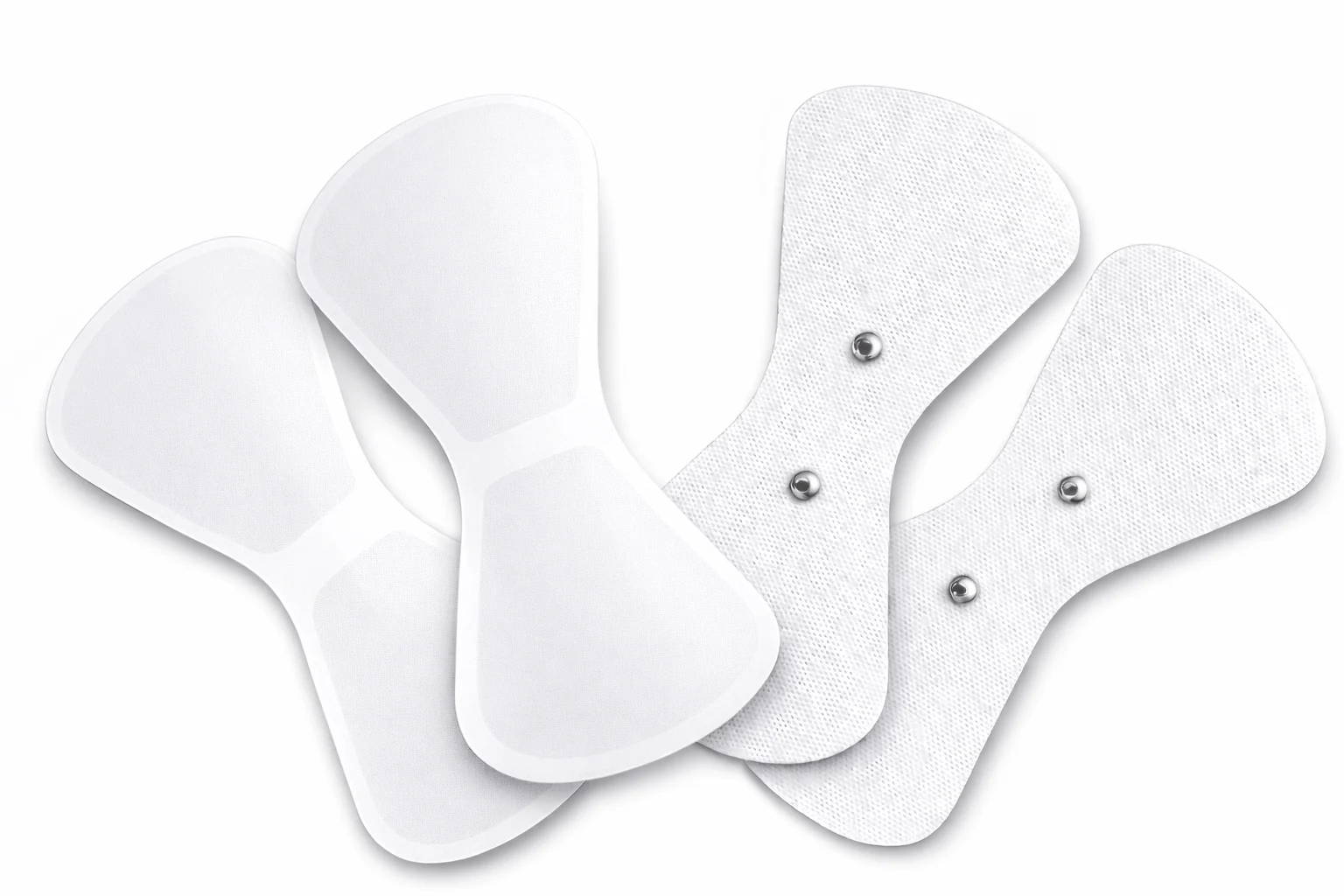
Our electrode pads use medical-grade hydrogel for a secure, lasting grip and comfortable skin contact that supports reliable stimulation. Each pad is reusable up to 80 times, offering better long-term value than single-use pads. Actual pad life depends on skin preparation, use and care. Replacement packs include four pads, so you can renew the contact surface while keeping your wireless units.
How TENS May Help Ease Pain: The Science Behind the Sensation
Our wireless TENS device delivers mild electrical pulses through pads on the skin to stimulate nerves. TENS—transcutaneous electrical nerve stimulation—is thought to ease pain by changing how pain messages are processed and engaging the body’s own pain-relief mechanisms.
Turning Down Pain Messages
One explanation is the “pain gate” mechanism: stimulation of sensory nerves can reduce the transmission of pain messages in the spinal cord before they reach the brain. Think of it as turning down the volume of a pain signal, rather than repairing the source of the pain.
Engaging the Body’s Own Pain Relief
TENS may also encourage the release of endorphins, chemicals involved in the body’s natural pain relief. These mechanisms help explain why some people notice temporary relief during use, although TENS does not work for everyone.
For Cindy, this provides context for the noticeable relief she describes around her SI joints. Her account cannot tell us which mechanism contributed or prove that TENS treated her arthritis or Behcet’s disease. The aim is temporary symptom relief; follow the device instructions and your clinician’s advice.
A Brief Note on Cindy’s Neck Relaxation Routine
Cindy also describes tense muscles and neck discomfort alongside her training routine. With Wellue’s
Electric Neck & Shoulder Relaxer, which she calls a “neck stretcher,” she says she lies on the floor, closes her eyes and chooses an option. She mentions traction, red light and compression options, and describes the experience as easy to use and relaxing for her neck and shoulders.
Cindy’s photo of the neck and shoulder relaxer and its controller.
Frequently Asked Questions
A few useful details from Cindy’s experience.
Which TENS device did Cindy use?
She used the Wellue Wireless 4-Channel TENS Therapy Device, a wireless system with four wearable units and an included handheld remote.
What did Cindy like about wireless TENS?
She reports noticeable relief from her SI joint arthritis discomfort and especially likes the lack of tangled cords. These are her personal observations, not a guarantee of results.
Where did Cindy place her TENS pads?
In her written account, she describes two pads on her lower back to the sides of the SI joints and two on her buttocks where she feels the most discomfort. Her photos show a separate thigh-wearing setup. Ask your clinician for placement advice specific to you.
Does this story show that TENS treats Behcet’s disease or arthritis?
No. Cindy’s awareness work provides the background to her story. Her report concerns her experience of discomfort relief; it does not show treatment of the underlying disease or joint damage.
How does TENS relate to temporary pain relief?
TENS stands for transcutaneous electrical nerve stimulation. It uses electrical stimulation through skin-contact pads and may provide temporary pain relief for some people. It does not work for everyone.
Where can I learn about settings and safe use?
THE DEVICE BEHIND THE STORY
Explore the Device Behind Cindy’s Story
For Cindy, the combination of personal comfort and a setup without tangled cords is what makes this experience memorable. As she continues backpacking for awareness, she says it is comforting to have Wellue’s support.
See the device details, included accessories and instructions to decide whether the wireless setup fits your needs.
Use left/right arrows to navigate the slideshow or swipe left/right if using a mobile device